
Jackson City Directory Collections at MDAH
The Mississippi Department of Archives and History anchors the documented Jackson city directory holdings at 200 North Street. It is known as MDAH. The earliest surviving piece is an 1860 professional and business directory. From there the shelf moves into named publisher runs and a Polk continuation. Treat the catalog as a locator, not a guarantee. It lists individual reels, microfiche, shelf records, and publisher notes. But it cannot prove that every edition or reverse section survives. The volumes stay in the reading room and do not circulate. Confirm the reel or volume before making the trip.
| Collection | Years | Where Held | Access |
|---|---|---|---|
| J.L. Power professional and business directory | 1860 | MDAH Media Room microfiche and photocopy collection | Reading-room use; catalog notes missing or misnumbered advertisement pages. |
| Jackson directory catalog run | 1910-1953, with documented editions in 1910, 1916, 1922, 1925, and 1927-28 | MDAH Media and Archival Reading Rooms | Microform or preservation copy; the catalog identifies selected reels and formats. |
| Jackson, East Jackson and Pearl City directory | 1935-1953 | MDAH directory collection | Reading-room access; the subtitle reaches beyond a strict Jackson-only search. |
| Polk's Jackson city directory | 1954-1984/85 | MDAH Media Room shelf record | Cataloged continuation; the public catalog row does not state every annual gap. |
| Classified buyers guide and numerical telephone directory | 1940 | MDAH, 917.62511/C614/1940 | Reading-room companion source for business and numeric telephone evidence. |
The MDAH Jackson directory catalog record identifies the Jackson 1910-1953 microform and its call numbers. Jackson 1913-14 material sits on microfiche, listed separately, while Jackson 1952-53 material is on microfilm. The sequence is not unbroken, so do not assume every year is present. When one exact Jackson year matters, the Polk shelf record needs a staff check first. A catalog check works too.
Jackson's 1860 Directory Survives
The earliest verified lead for Jackson people and businesses is the 1860 Professional and business directory of the city of Jackson, a volume associated with J.L. Power. MDAH catalogs a 32-page original reproduced on microfiche, with a photocopy call number attached. One caution stands out. The catalog warns that advertisement pages 27 and 28 are missing or misnumbered. So a gap in the page sequence says nothing about whether a firm or person was left out of the listings.
Treat this volume as a starting point for dated historical questions, not as a stand-in for later household evidence. The statewide archive holds many other Hinds record types. So an 1860 Jackson directory find can be weighed against land, court, and tax material through the right record group. Note: Record the edition, call number, and page image or reel position before treating any directory statement as family-history fact.
Jackson City Directory Reels and Reading Rooms
MDAH splits Jackson research across three spaces: the Public, Archival, and Media Reading Rooms. Genealogy books live in the Public Reading Room. Original records and rare works go to the Archival Reading Room. Microfilm, newspapers, and census material stay in the Media Room. Hours differ by room. The Public Reading Room runs Monday 9 to 5, Tuesday through Friday 8 to 5, and Saturday 8 to 1. The Archival and Media rooms close earlier, at 4:30 weekdays and 12:30 Saturdays.
A free reader card takes only photo identification. Copiers run on prepaid card credit. Copies cost 20 to 50 cents per page, and no change or refunds are given. Anyone can search the catalog without an account, but checking out materials requires one. Directory reels are on-site research material, period. Ask staff which room holds the precise item. Do not assume every reel sits in one place.
The MDAH Digital Archives Jackson maps collection displays dated Jackson map material. It spans 1946 through 2011.
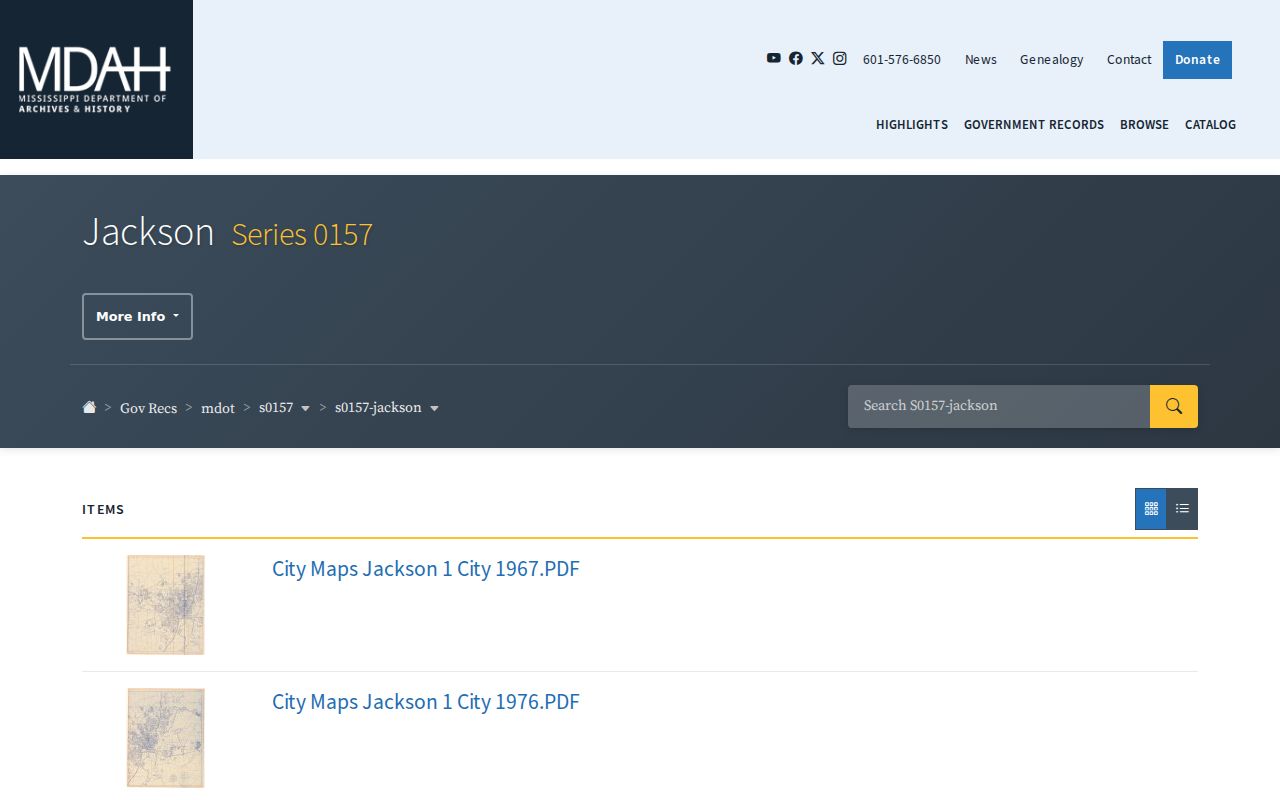
A map never names a Jackson directory resident. It still earns its place in the search. Comparing a dated map with a directory year can test street continuity and city-limit context before an address is carried from one edition to the next.
Reading a Jackson City Directory Entry
The MDAH catalog record describes the Jackson material as city and telephone directories. It lists contributor or publisher, date, subject, microform format, collection, Media Room status, and call numbers. What it does not do is show a page image. No actual Jackson entry is visible there. That boundary matters. Before claiming an edition prints a spouse, occupation, employer mark, widow notation, or abbreviation key, inspect the reel page itself. The reel holds the entry, not the catalog record.
| Cataloged facts | Title, contributor or publisher, date, microform format, collection, call number, and no-loan status can be confirmed from the catalog record. |
|---|---|
| Name evidence | Copy the spelling, initials, and section title from the page actually viewed. Do not silently expand initials. |
| Address evidence | Record an address only when it is printed in the relevant name or address section, together with the edition year and page. |
| Household or work details | Spouse, occupation, employer, boarding, widow, owner, and telephone details must be treated as edition-specific fields to inspect, not assumed fields. |
| Cross-check | Compare a directory statement with a census, deed, map, or newspaper record before drawing a conclusion about a household. |
- Criss-cross directory
- A reverse or street-order arrangement that can connect an address to listings when the particular volume actually includes that section.
- Householder index
- A name-oriented listing a researcher may encounter; verify how a particular volume defines and organizes it before using it as household proof.
- Abbreviation key
- A guide sometimes printed in a volume. No Jackson key was visible in the reviewed catalog material, so photograph or transcribe the key from the edition in hand.
Jackson Directories Beyond City Limits
Publisher names and subtitles sharpen the directory shelf. MDAH identifies Southern Directory Company for 1910. Ernest H. Miller compiled the 1916 volume. Piedmont Directory Company published it. Jackson City Directory Company handled 1925 with Tucker Printing House. The 1935-1953 editions carry the subtitle Jackson, East Jackson and Pearl City, Mississippi, city directory. So a search limited only to a present-day Jackson label can miss an entry. It may sit filed under the wider title.
The 1940 Jackson classified buyers guide and numerical telephone directory is a distinct record type. It can corroborate a business or a numeric telephone reference. It is not proof that every Jackson household had a telephone. Nor does a name prove the occupant of a particular building. The record type and its section matter as much as the year.
The MDAH Hinds County finding aid points Jackson researchers toward county microfilm and original-record alternatives. This helps when a Jackson directory year or record type is not available on the directory shelf.
The archival collections around Jackson reach past the printed name lists. A directory lead can be set beside a county record from roughly the same era, which widens the picture considerably.
Jackson City Directory Timeline
Directory coverage has firm waypoints. It is not a promise of every annual issue. The timeline helps you pick a first reel, then check adjoining editions and the catalog before concluding that a gap means a household left Jackson.
- 1860: the J.L. Power professional and business directory is the earliest verified Jackson directory lead.
- 1910 and 1916: MDAH identifies the Southern Directory Company edition and the Ernest H. Miller/Piedmont edition.
- 1922 through 1928: catalog evidence identifies 1922, 1925, 1927-28, with 1913-14 on microfiche.
- 1935 through 1953: the catalog subtitle expands to Jackson, East Jackson and Pearl City.
- 1954 through 1984/85: Polk's is cataloged as a continuation, while exact annual gaps remain unstated.
That caveat guards against a common Jackson error. A catalog span is not a page-by-page inventory of what survived. Whether a given Jackson volume is present must be confirmed through the catalog or at the Media Room desk.
Tracing Jackson Directory Households
Start a Jackson household trail from the name spelling in one directory year. Then test nearby editions instead of leaping across decades. Keep the address, initials, business affiliation, and any household notation bundled together, because that small detail set separates two residents who share a name. Not every edition carries a street or reverse section. Inspect the volume's contents first, then decide whether it works as an address index.
- Locate the person in one Jackson city directory and capture the printed name, address, page, and edition year.
- Check the preceding and following available editions for spelling variants, address changes, or a different business affiliation.
- Inspect an address or reverse section when the volume includes one, then compare nearby listed names without assuming they share a household.
- Pair the directory year with the closest public federal census year: 1900, 1910, 1920, 1930, 1940, or 1950.
- Use a deed, tax record, map, obituary, or cemetery source to test whether the person was an owner, occupant, relative, or simply a business contact.
Remember the dating quirks. A directory's publication year is not necessarily its canvass date, and the census follows its own enumeration date. For an address-keyed search of today's residents, turn to the county tools on the Jackson street directory page rather than stretching a historical listing into a claim about the present.
Jackson Maps, Papers, and Obituaries
A changed address in a Jackson directory does not always mean a family moved. Maps can show whether the street, the block, or the corporate limits themselves shifted first. MDAH's bibliography lists Jackson Sanborn map years from 1904 through 1962. The Library of Congress offers a free 43-sheet 1914 Jackson Sanborn map gallery. These sheets document streets and building footprints, not the people inside them.
Newspapers add another layer entirely. Chronicling America lists the Jackson Daily Clarion for 1866 through 1888, plus other Jackson titles. An obituary, marriage announcement, business item, or probate notice can corroborate a directory lead. Always check OCR text against the scanned page itself. MDAH's cemetery index also gives call-number and page leads for Jackson cemetery material. Its listings include Greenwood, Cedar Lawn, and Willow Park.
Jackson Community History Sources
No single volume captures everyone. A Jackson directory can underrepresent parts of the community. That happens where the canvass method, section design, or business focus was uneven. MDAH's Hinds source-material collection holds long-time-resident interviews and biographies. It also holds church records, cemetery material, veterans files, and African-American Jackson research. For African-American Jackson history in particular, the archive catalog and newspaper holdings run as useful parallel routes. So do Tougaloo College collections and Jackson State University materials. Treat no volume as socially complete.
Greenwood shows how a companion record can deepen the trail. Its historical material places the cemetery beyond Jackson's original northwest corner at High and West Streets. It notes the 1837 city connection and records its 1899 rename. Cemetery research can close a family trail. A directory supplies the earlier address or affiliation. Together the two build a better dated record than either one alone.
Note: Keep the exact source, year, page, and record type with each Jackson directory finding so later researchers can revisit the same evidence.