
Jackson Previous Residents by Era
Match the record to the era you are chasing. Recent Jackson ownership questions start with a parcel. The Hinds County Landroll names the present taxpayer for a Jackson parcel, while the Hinds Chancery Clerk's General Index carries the recorded transfers. For earlier Jackson households, MDAH supplies directories, county microfilm, maps, and archival material. A census snapshot can place a Jackson household. Its date and boundaries may differ from a directory or a tax record, so compare them carefully. That is why the table keeps these sources separate.
| Source | Years It Covers | Where Held | What It Shows |
|---|---|---|---|
| Hinds General Index | Online cutoff not stated; older index and books through county and MDAH holdings | Hinds Chancery Clerk; MDAH microfilm and originals | Grantor, grantee, deed or deed-of-trust category, dates, instrument leads, and legal-description clues. |
| Hinds Landroll and ownership maps | Current annual roll; deeds filed as of January 1 | Hinds Tax Assessor Landroll | Taxpayer or owner clue, mailing and situs addresses, parcel or map number, class, value, and exemption clues. |
| Jackson directories | 1860; 1910-1953; Polk 1954-1984/85, with gaps | MDAH Media Room and catalog | Historical occupant or business lead when the edition includes a usable name or address section. |
| Federal census | 1900-1950 currently public under the ordinary 72-year release cycle | National Archives and library databases | Household composition at an enumeration address, subject to boundary and date limits. |
| Maps, permits, and certificates | Map years vary; historic online permit coverage is not stated | MDAH, Library of Congress, Jackson Code Services, and Municipal Clerk request route | Street continuity, building footprints, or work chronology, not a complete resident list. |
Let the question pick the record. A recent Jackson transfer starts with the parcel. Older households are different. Jackson directories and the census often speak more directly to who lived at an address, and the General Index deed trail covers ownership instead. When a Jackson record is not online, the Chancery Clerk, MDAH microfilm, or an identifiable public-record request is the fallback, not a guess about the missing year.
Jackson Records Begin With Parcels
A Jackson past-residents search works best from the parcel outward. The Hinds County Tax Assessor Landroll lets you query by taxpayer name, street name, parcel number, building type, or map number. Street searches have quirks. The county advises dropping suffixes like Street, Drive, Road, and Lane along with their abbreviations. Numbered streets sometimes answer only when you try both the numeral and the spelled-out form. Copy the exact situs address, the taxpayer mailing address, the parcel number, and the map number before you chase deeds. Those identifiers survive old spelling changes better than any name.
Remember what the landroll is not. It is not a census. A taxpayer may live at another address entirely. Ownership can sit with an estate, a trust, a corporation, or joint owners. Timing matters too. The annual roll reflects deeds filed by January 1. A deed recorded near that date may not appear until the next cycle. A homestead or Class 1 flag hints that the owner occupies the property. Yet it names no one person inside the building.
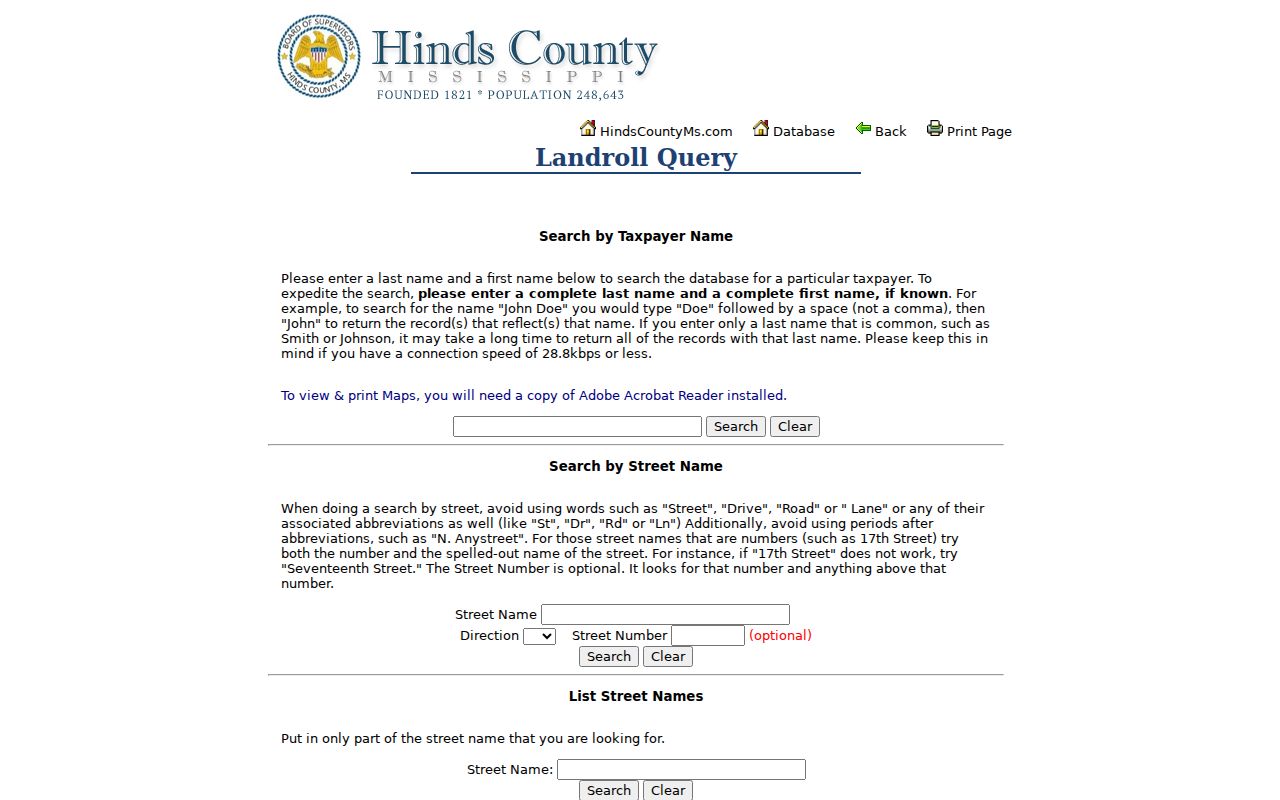
The Jackson Landroll's search modes work separately. That is why a Jackson past-address search should keep the parcel and map reference, not just a person's name.
Jackson Resident Records Start Narrow
The free Hinds General Index is the main online Jackson deed lead. Names go in last name, space, first name. The role control lets the searcher pick Grantor, Grantee, or Both. The category control works the same way. It offers Deed of Trust, Deed Book, or Both, and a date range narrows things further. Start with the current Jackson owner as grantee. The result points to the preceding Jackson owner. Common surnames need a limited period and the role filter because the public form caps results at 500.
The General Index page for Jackson deeds posts no online start year. That silence proves nothing about older deeds. They may still exist on file. A stopped online result only moves the work offline, to the Jackson Chancery Clerk counter, MDAH county microfilm, or a request naming the record needed. The clerk records and preserves instruments, but staff will not run a title search or prepare a deed.
The controls are plain once you see them. The Hinds General Index search form shows the role, category, and date controls used for that first Jackson deed pass.
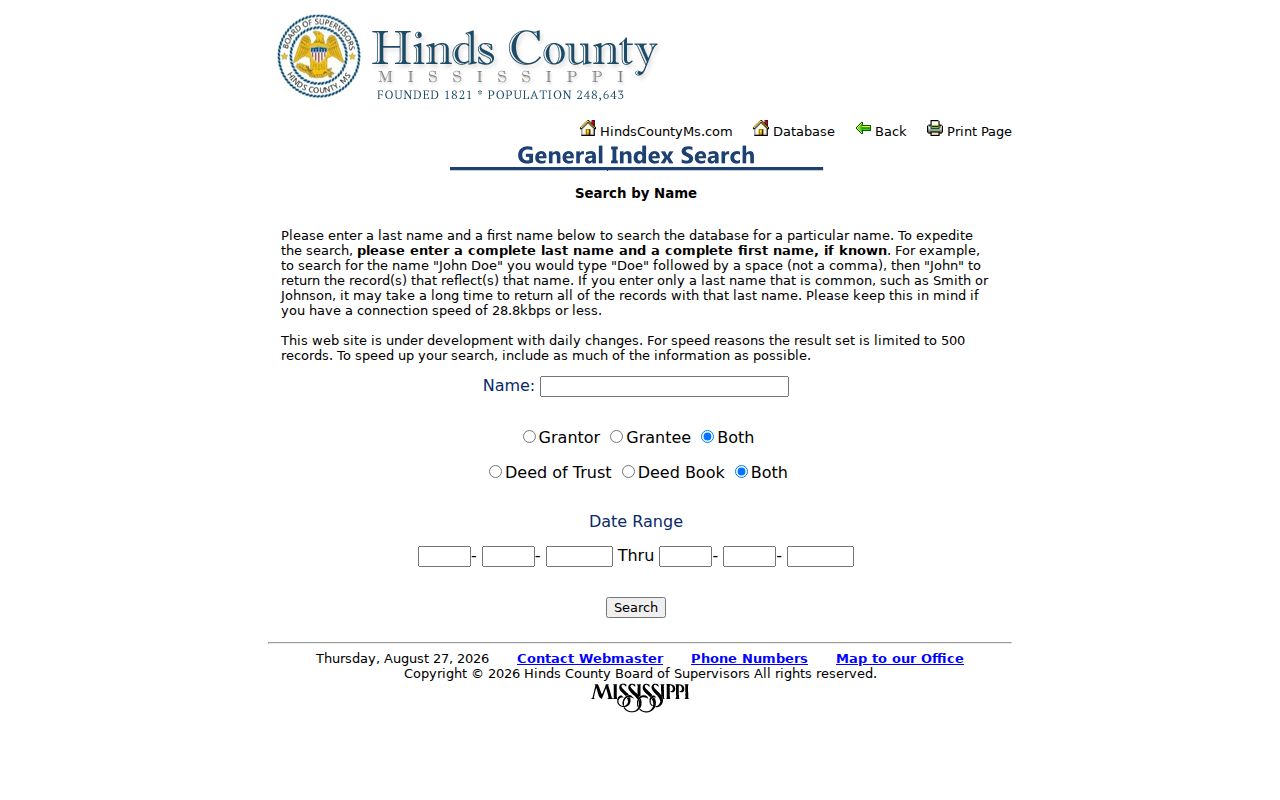
Details matter in the Jackson deed index. Record the exact query, the date range, and the role with every result, especially when a similar name or business entity appears more than once.
Tracing Jackson Previous Resident Deeds
A Jackson chain of title is a sequence of recorded transfers, not a list of former occupants. Start with the current Landroll owner. Add the Jackson parcel or legal description. Find that owner as grantee in the General Index, and record the grantor, grantee, recording date, book and page or instrument number, legal description, and any prior-instrument reference. Then search the seller as grantee in an earlier date range. The seller's purchase leads to the earlier transfer. The sequence repeats.
- Save a dated Jackson Landroll result and the parcel, map, subdivision, or legal-description clue.
- Search the current Jackson owner or entity as Grantee in the General Index, using a narrow date range and the suitable deed categories.
- Read the Jackson instrument reference and compare its legal description to the parcel before treating it as the same property.
- Search each seller as Grantee in an earlier range, including initials, spelling variants, joint owners, estates, trusts, or entities when relevant.
- Repeat until the online trail stops, then use the Clerk, MDAH microfilm, or an identifiable request for the earlier record.
- Grantor
- The person or entity conveying an interest in a recorded instrument.
- Grantee
- The person or entity receiving that interest. In a backward search, a prior seller is often searched as grantee to locate an earlier acquisition.
- Chain of title
- The documented sequence of recorded ownership interests tied to the same property.
- Legal description
- The lot, block, subdivision, acreage, section, or metes-and-bounds wording that identifies land more reliably than a street number in old records.
Not every jump in a Jackson sequence is an ordinary sale. Quitclaims, tax deeds, and foreclosures often explain the gap. Check the instrument type before labeling it. A later recording can change the picture, and when legal ownership matters, the clerk's warning means a title professional should review the completed chain.
Jackson Records Bridge Old Addresses
Old Hinds deeds rarely cite a Jackson street number. A parcel may instead be described by subdivision lot and block, section-township-range, acreage, or metes and bounds. Work through that wording link by link across the Jackson deed chain. The county's sectional subdivision, acreage, and condominium indexes help. So do the Jackson parcel map and the GIS viewer. Together they can bridge a record that carries no familiar address at all. Never match two deeds just because the street numbers look alike.
Historic maps offer a second check. The MDAH Digital Archives Jackson maps collection spans 1946 through 2011, while the Library of Congress posts a 43-sheet 1914 Jackson Sanborn set. Maps show streets, boundaries, and footprints, never the residents.
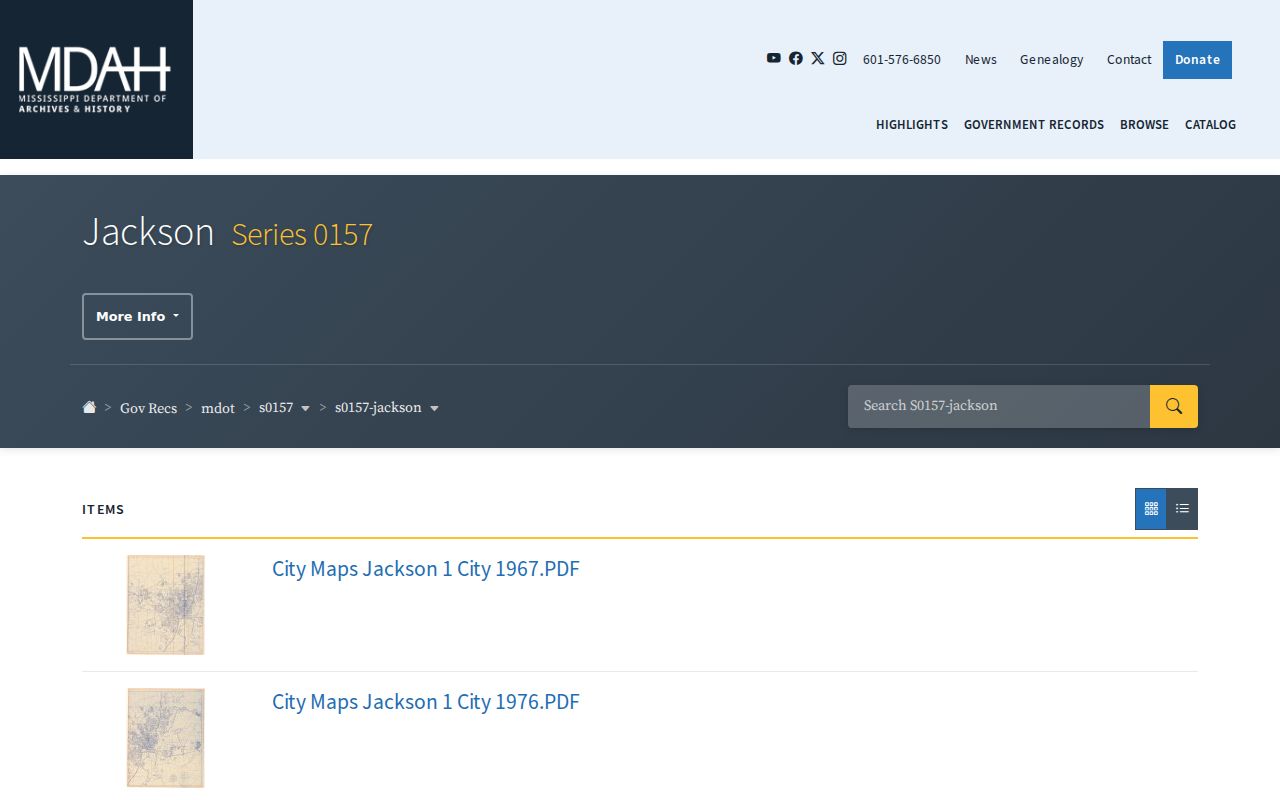
Note the map year and sheet or item reference in your records. Then set that map label beside the Jackson legal description before drawing any deed conclusion.
Jackson Past Residents in Directories
A deed chain shows recorded ownership, nothing more. It will not show who lived there. Directory material fills part of that gap. Jackson coverage exists for 1860, a documented 1910-1953 run, and Polk's 1954-1984/85 continuation, with gaps that still need verification. An address or reverse section helps only when the individual edition actually contains one. The catalog promises no complete reverse-directory run. Check the reel contents before counting on a street listing for any given year.
Treat each address hit as a dated lead only. Return to the alphabetical section and compare spellings, initials, stated affiliations, and nearby listings. The 1940 Jackson classified buyers guide and numerical telephone directory adds business and phone evidence. It proves neither that every address had a phone. Nor does a listed name guarantee the building's occupant. Full descriptions of the historical volumes, with documented publisher runs and reading-room access, sit on the Jackson city directories page, separate from this address-by-address trail. Keep the two tasks distinct.
Jackson Resident Census and Directories
Pair each historical Jackson address with the nearest public census. The available schedules cover 1900, 1910, 1920, 1930, 1940, and 1950. A directory may supply an address or business link between census years. The census fixes a household at its own enumeration date. A match gains real strength when the address, initials, age pattern, spouse or household relationship, and nearby records all point the same way. One source alone is rarely enough.
- Write down the exact directory year, page, name spelling, and printed address.
- Choose the nearest public census year and locate the relevant enumeration address with boundary changes in mind.
- Compare household composition and the address carefully, allowing for canvass timing and street changes.
- Use a deed or tax record to distinguish an owner from an occupant, then add a newspaper or cemetery lead only if it fits the dated trail.
A Jackson directory's publication year may not match its canvass date. Keep the two dates apart. The 1960 census and later schedules remain restricted. Note: Treat a census and directory pairing as corroboration, not as a reason to erase a timing difference between the two sources.
Jackson Resident Maps and Endpoints
Maps, permits, obituaries, and probate fill gaps. None of them replaces the deed chain. MDAH's bibliography lists Jackson Sanborn years 1904, 1909, 1914, 1918, 1925, 1946, and 1962. The Library of Congress 1914 Jackson Sanborn gallery is a carefully dated street and building source. It supports address continuity, not a named-resident claim.
Jackson Code Services keeps permits, inspections, certificates of occupancy, complaints, and related correspondence. The city publishes no public historical permit index. Request a specific permit, inspection, certificate, or address-and-date-range record through the city route. Obituaries, cemetery records, and probate help separate a deceased former occupant, an heir, or an estate from the recorded owner. Label each role in your notes.
Jackson Resident Roles Are Different
A Jackson past-residents search has one firm limit. Owner, taxpayer, and occupant are not interchangeable. The Jackson Landroll names a taxpayer or ownership clue. A Jackson deed, by contrast, records a transfer party and a legal description, nothing about daily life at the property. A directory or census can place an occupant or household at a date, but only when its entry is actually present. A voter record, if lawfully obtained, concerns registration rather than a complete household roster. Assign only the role a dated source supports. Renters, household members, protected-address participants, and people outside a particular record system may never appear.
Lawful use. Use Jackson address history for family history, estate or heir work, property curiosity, or verifying a dated record. Do not use a past-resident lead to track, harass, or harm a living person.
Every Jackson trail ends somewhere. Preserve the source and its limit when it does. The Mississippi Public Records Act route works best for an identifiable Jackson record and custodian. An office cannot solve an open-ended Jackson history question. That honesty keeps an incomplete result usable and gives the next researcher a clear place to resume.